TLDR: here's how I did it
- use Grokbot's VM to sign into Lyssna and create an unmoderated test based off your hosted html prototype
- tell your agent to set up your prototypes to have event listening for the task you are testing for on posthog
- use posthog to evaluate experiments and evaluate their responses without lifting a finger
- compare lyssna transcript/video results to prototype results
- design with user testing earlier and faster to help the creative process
Designing for usability in 2026 probably gets an eye-roll. We're building faster than ever and slowing that down to get some feedback feels so pre-2026. But testing assumptions is good and if you can increase the speed to insight, it can aid your design and help you make less assumptions and in-turn make better decisions.
I would design a workflow, set up an unmoderated test for 5 users, run the test and then watch the results.
For example, in one round of testing I tasked people to set up an AI chatbot for their app and 0/5 people were able to complete the task. Interestingly, every tester self-reported they had completed the task but had only completed one step of the setup.
In the second round, I set up a clear onward journey, re-ran the test, and 5/5 were able to complete it.
The user testing was valuable but the setup was long, boring, and felt really at odds with how design is working in 2026.
I had three main issues
- It's slow to construct an experiment on Lyssna. The MCP is read-only and not write. So creating an experiment was taking too much time.
- I can't trust the results so it takes up too much time for manual review. I'm designing flows in html prototypes and not Figma and Lyssna is doing a bad job for this. Lyssna lets you set a URL, and record the video and voice. But because you can't set the goal, you are relying on self-assessments of completion. Testers think they have completed a task, but have they really?
- Missing info. A video is just a bunch of frames, but there's interesting information being lost. How long did it take for each tester to get through a flow? Did a particular point have a spike in length of completion? Why?
So I sped this up, and I think this is really just scratching the surface of how user-testing could be incorporated into making products.
How to set it up
Once
- Create a PostHog project and turn on session replay
- Have your agent add a small tracker to the prototype repo: pages, clicks and task steps
- Connect your agent to PostHog so it can read results
- Give your agent a browser login to Lyssna
Every test
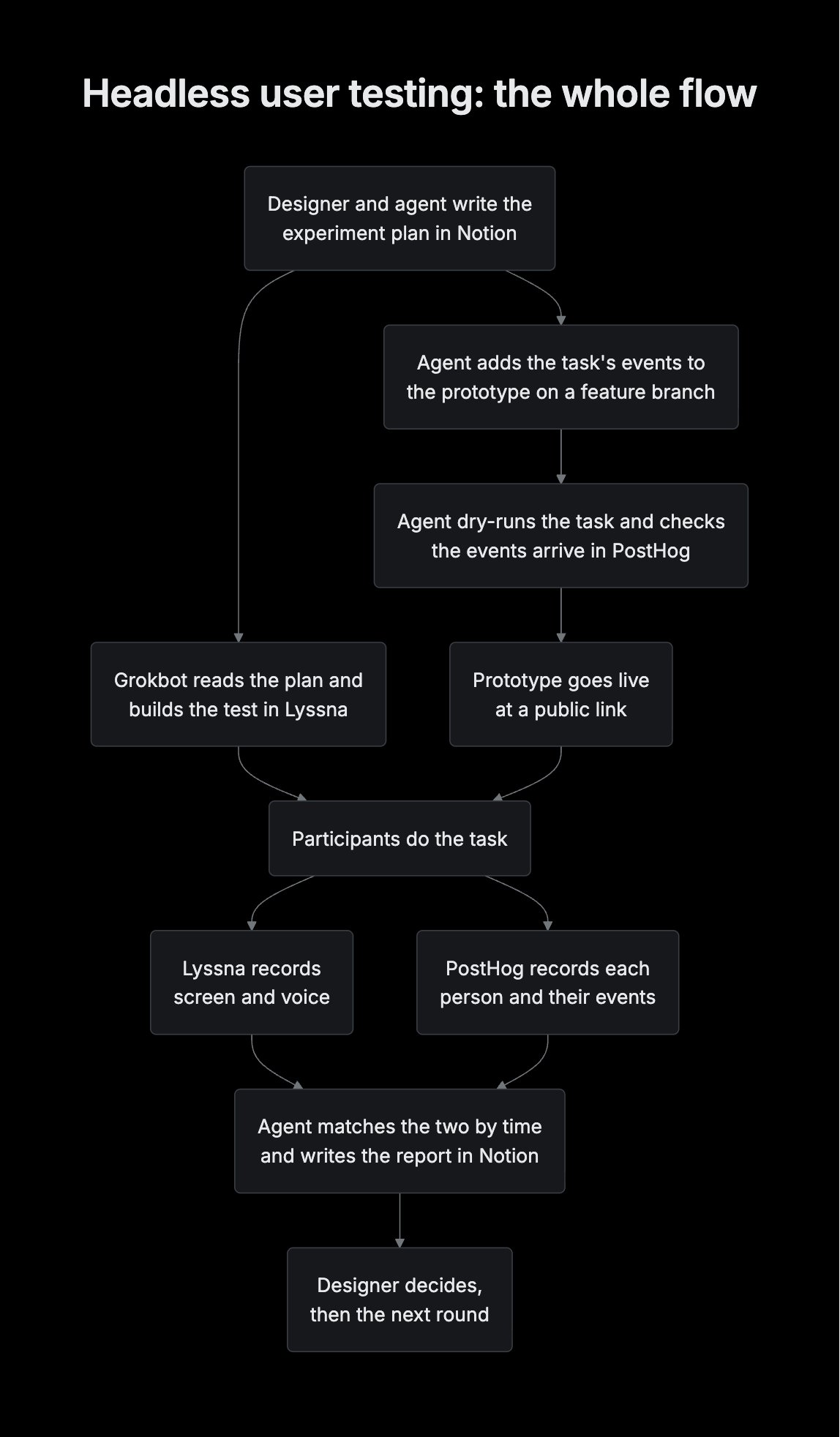
- Write the plan with your agent in Notion: task wording, expected steps, audience, pass mark (the agent often already knows this, so setup is instant)
- The agent adds the task’s events to the prototype and dry-runs it
- Publish the prototype at a public link
- The agent reads the plan, logs in to Lyssna and builds the test
- People take part: Lyssna records screen and voice, PostHog records what they did
- The agent matches the two and writes the report
What's next
I believe this is just scratching the surface, and by removing the barriers of user-testing I can imagine a world where:
- usability tests are kicked off as you receive an updated build
- In the age where everyone is a builder, have people verify their designs before shipping